

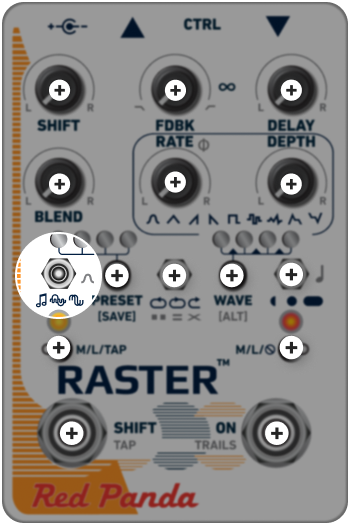
SHIFT MODE
The left toggle switch selects one of three pitch shifting modes. The SHIFT knob adjusts the amount of shift applied. These controls are only active if the SHIFT footswitch is on (left LED is orange).
-
 TRANSPOSE Shift the pitch one octave up or down in semitone steps. This mode is useful for standard pitch shifting, arpeggiated delays, harmonized delays, and generating chords from single note lines.
 -
 DETUNE Smoothly shift from a 4th down to a major 3rd up, with emphasis on small pitch ratios. Small shifts create chorused or detuned sounds. When used with delay, subtle detuning will cause each repeat to change slightly, creating a natural evolution as the sound decays.
 -
 PHASE/FREQUENCY SHIFTING Adds phase shifting with the knob set near center; higher and lower settings use frequency shifting (single sideband modulation), which destroys the harmonic relationship between signal components. Each partial is shifted up or down by a fixed number of Hertz (0-500). With frequency shifting in the feedback loop, the harmonic structure of the notes is pulled farther apart with each repeat.
MODULATION DESTINATION

Holding [ALT] and moving this toggle will assign the LFO modulation (see WAVE, RATE, DEPTH) to one of three destinations:
-
 BLEND Assigning modulation to BLEND gives you amplitude modulation, which creates a tremolo effect in the shape of the chosen LFO. At maximum DEPTH, the signal at the bottom of the waveform will be completely muted. Inverse envelope modulation can create delay repeats that duck when a new note is played.
 -
 SHIFT Pitch modulation is typically used for creating vibrato. Modulation will occur relative to the SHIFT control position. With an LFO, the shift amount will change smoothly above and below the control position. Envelope and inverse envelope modulation will adjust smoothly to or from the specified pitch as the note decays.
 -
 DELAY (default) Delay modulation changes both pitch and time, like an analog or tape delay. LFO will modulate above and below the set DELAY time for various delay, chorus, flanging, and primitive pitch shifting sounds. Envelope and inverse envelope will increase or decrease the delay time as the signal level increases.