
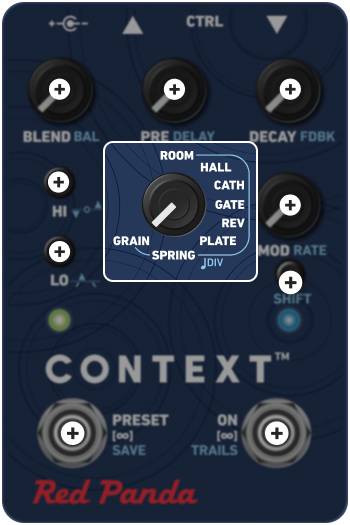
ROOM Fast build-up with multiple initial reflections.
HALL Emulates a concert hall. Slow build-up with a longer initial delay.
CATHEDRAL Emulates a large, reflective space.
GATED Gated reverb with nonlinear decay. Known for big drum sounds.
REVERSE Reverse reverb. Reflections get louder and brighter as time passes, giving the impression that the signal is played backwards. Typically used with 100% wet signal. Modulation knob adds a wash of forward reverb.
PLATE Emulates studio plate reverbs, which use thin sheet metal to create reflections. Bright and dense. Modulation adds rich stereo chorusing. For more "bend", increase the modulation rate to ~1:30.
SPRING Simulates a spring reverb using the algorithms and techniques used in 1980's reverbs, but with more processing power. Low decay works well for adding subtle ambience without an obvious reverb effect. Middle settings match spring reverb settings on guitar amps. At higher decay settings, it begins to sound unnatural.
GRAIN Granular reverb, with some similarities to the Ursa Major SST-282 Space Station, released in 1978. It used a single delay line with modulated taps to create reverb effects. The Context 2 can produce the same kind of ghostly reverb effects, but is not a direct model.
Hold SHIFT while turning the knob to set tap divisions for any active delay.
- ROOM Off
- HALL Half note
- CATH Dotted quarter note
- GATE Quarter note
- REV Quarter note triplet
- PLATE Dotted eighth note
- SPRING Eighth note
- GRAIN Eighth note triplet
Divisions for pre-delay and tremolo rate are also available, via MIDI or our web editor. By default, the delay time is set for quarter notes and divisions are off for other parameters.